
September 24, 2026
Residency Visas for Mexico: Temporal vs Permanente Explained

By Jason Thompson · Real Estate Agent, Vive Real Estate
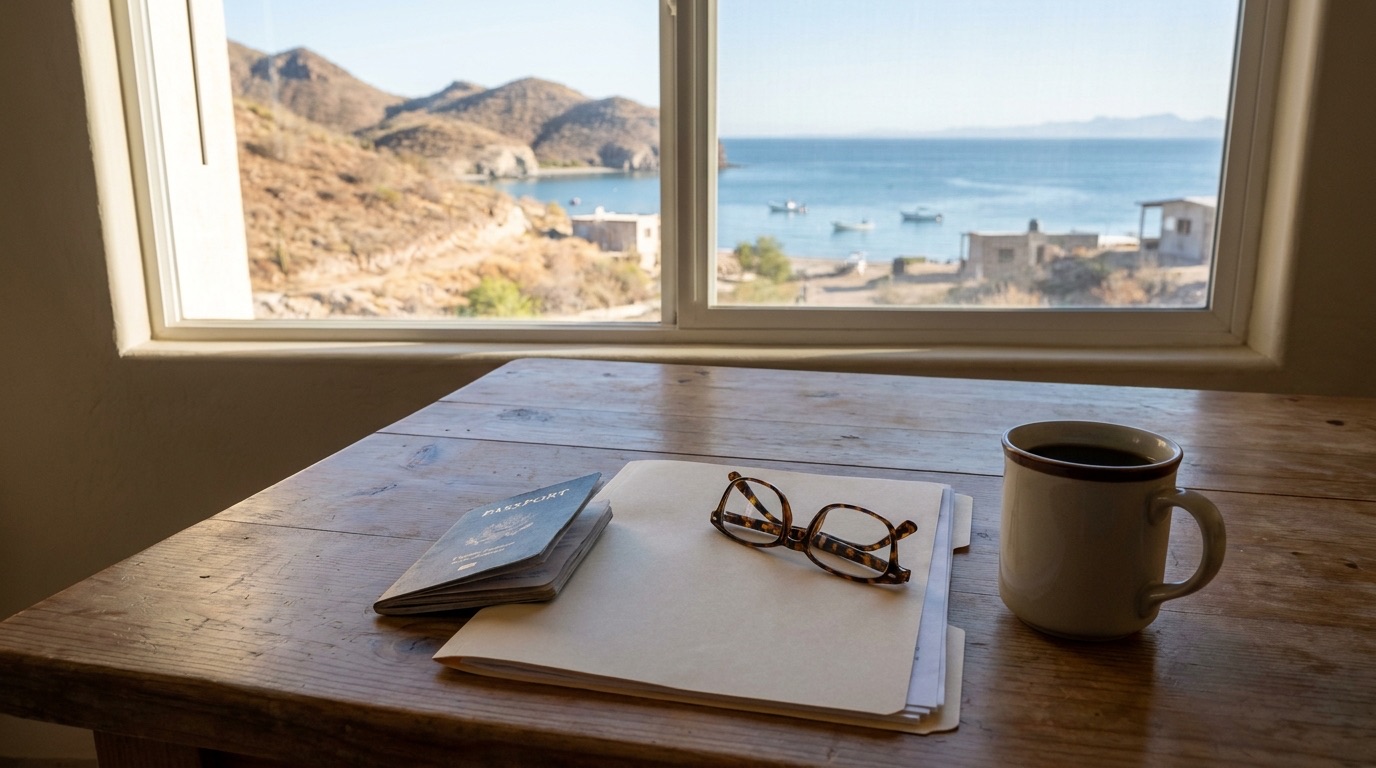
If you're planning more than a casual vacation in Mexico, you'll eventually meet two Spanish phrases: residente temporal and residente permanente. Understanding how these two residency types work is one of the first practical steps in any retirement plan, and for most retirees it turns out to be a well-worn path rather than a bureaucratic nightmare.
This guide explains how the two statuses work, how retirees usually qualify, and how to decide which one fits your situation. One caveat up front: income thresholds and consulate practices change every year and differ from one consulate to the next. Treat this as orientation, not legal advice, and confirm the specifics with the consulate where you'll apply.
The three ways to be in Mexico legally
For visitors and retirees, there are essentially three tiers:
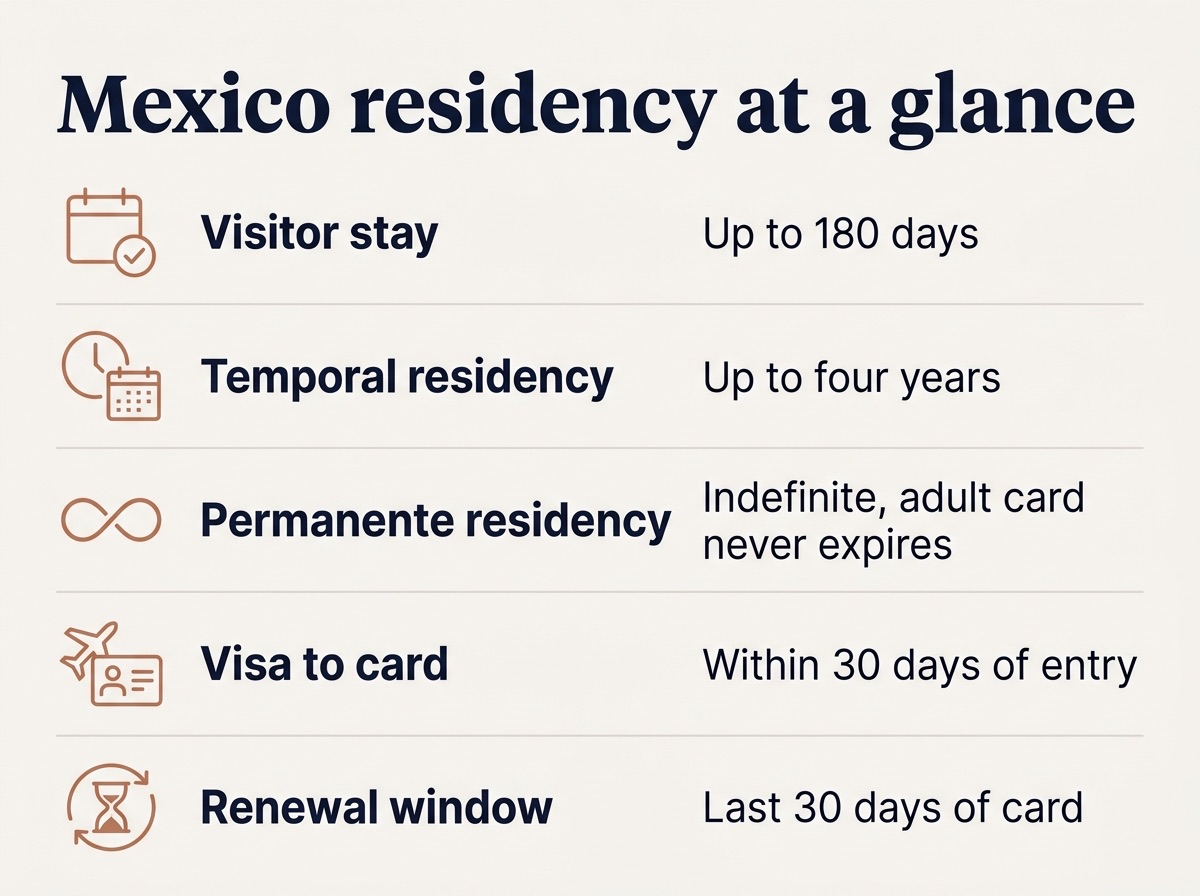
- Visitor (tourist) entry. Mexico's Migration Law lets a visitor stay for up to 180 days per entry, but the immigration officer at the border or airport decides how many days you actually get, and it can be fewer. There's no income requirement, and no right to live in Mexico long term.
- Residente temporal (temporary resident). For people who want to stay longer than 180 days, for up to four years in total. Cards are issued for one to four years, and you renew in Mexico until you reach four years.
- Residente permanente (permanent resident). Indefinite residency (an adult's card has no expiry date and needs no renewal), the "we live here now" status.
Many snowbirds happily use visitor entries for years. Residency starts to make sense when you stay longer, own property, want to stop worrying about how many days you'll be granted at the border, or simply want your status settled.
How retirees usually qualify: economic solvency
The most common route for retirees is showing economic solvency, meaning proof that you can support yourself. Consulates accept one of two kinds of proof:
- Monthly income (pensions, Social Security, CPP/OAS, investment income) above a set amount, shown on statements for the past six months, or
- Savings or investments with an average monthly balance above a much higher amount over the past twelve months.
The thresholds are recalculated every year from a Mexican reference value, and each consulate converts them into its own currency. That's why the numbers you see online rarely match. Here's what three consulates were publishing when we checked in September 2026:
| Consulate (page date) | Temporal: monthly income | Temporal: average balance | Permanente: monthly pension | Permanente: average balance |
|---|---|---|---|---|
| Tucson, AZ (updated Dec. 31, 2025) | over US$4,393 | over US$73,215 | over US$7,322 | over US$292,859 |
| Las Vegas, NV (2026 requirements sheet) | over US$4,630 | US$78,025 | not checked | not checked |
| Leamington, ON (updated Aug. 12, 2026) | over C$6,461 | C$108,894 | over C$10,832 | C$435,672 |
Notice that the Tucson and Las Vegas figures for the same year are different. That's normal, and it's the best argument for reading the page of the exact consulate you'll use shortly before you book. A few other things those pages spell out:
- Each applicant qualifies on their own. Tucson asks each person to show their own income unless they apply through family unity, and Leamington says the amount on a joint account is required per applicant. A spouse can often apply as a family member of the main applicant, with a much lower amount to show. Ask your consulate how it handles couples before you book appointments.
- Permanente for retirees is tied to a pension. Tucson states that for the permanent visa you must either be retired or have qualifying family ties.
- Bank letters matter. Several consulates ask for a letter from your bank confirming the account is yours, along with stamped or signed statements.
The application process, in broad strokes
As a general rule, you can't switch from visitor to resident while you're in Mexico. The Migration Law makes exceptions for humanitarian cases and for people with family ties to a Mexican citizen or legal resident. The normal sequence:
- Apply at a Mexican consulate in the US or Canada. Book the appointment (some consulates use the MiConsulado system, others take requests by email), bring your passport, photo, application form and financial proof, and pay the visa fee. Tucson and Las Vegas both listed a fee of US$56 in 2026. Las Vegas says processing can take 1 to 10 business days from the appointment.
- Get a visa in your passport if you're approved. It's good for a single entry.
- Enter Mexico and complete the canje. Within 30 calendar days of arriving, you go to an INM (National Migration Institute) office to exchange the visa for your resident card. INM has an office in Guaymas that serves the San Carlos area.
- Receive your resident card, which you'll show at borders and airports from then on.
Many retirees hire a local immigration facilitator to help with the in-Mexico paperwork, especially the first time. Fees vary, so ask for a written quote.
Temporal vs permanente: side by side
| Residente temporal | Residente permanente | |
|---|---|---|
| Length | Cards of 1 to 4 years; 4 years total | Indefinite |
| Financial proof | Lower threshold | Higher threshold |
| Renewals | Yes, at INM in Mexico | None |
| Path to the other | Eligible for permanente after 4 years as a temporary resident | Not applicable |
| Foreign-plated car (TIP) | Allowed, one vehicle | Not on the list of people who can get a TIP |
| Paid work | Only with a work permit tied to a job offer | Only with a work permit tied to a job offer |
| Often suits | Snowbirds, first-timers, people driving down | Committed full-timers |
The car question (it matters more than you'd think)
For snowbirds who drive down, the vehicle rules are often the deciding factor. Under Mexico's customs rules, visitors and temporary residents can temporarily import one foreign-plated vehicle, and its permit lasts as long as their immigration status. Permanent residents aren't on that list.
Sonora adds a wrinkle that helps San Carlos. Northwestern Sonora, down Highway 15 as far as Empalme, is a "free zone" where foreign tourists' vehicles need no import permit at all. The zone is written for tourists, though. If you hold a resident card, ask about your own vehicle before you count on it. Our guide to bringing your car to Mexico covers the permit rules in detail. If you plan to keep driving your US or Canadian vehicle down every winter, temporary residency or visitor entries usually fit better than permanente.
Timelines, costs, and keeping your status
A few practical realities that surprise first-time applicants:
- Timeline. Consulate appointments are often the bottleneck. The Leamington consulate, for example, says appointments are usually booked about two months out and recommends applying at least two months before you travel. After that come the consulate's processing time and the canje in Mexico.
- Costs. Budget for the consulate visa fee plus a separate INM fee when you get your card. INM fees vary by card type and length, so check the current amount when you file.
- Renewals. Temporary residents renew at their local INM office in Mexico, with no trip back to a consulate. INM accepts the renewal when your card has 30 calendar days or less left, so put the date on your calendar.
- Couples and dependents. Spouses often apply together, and a spouse can apply through family unity based on the main applicant's status. Ask your consulate how it treats joint finances.
Which one should a retiree choose?
A rough decision guide (confirm your own details with a professional):
- Wintering under six months and driving down? You may not need residency yet. Visitor entries plus Sonora's free zone cover many snowbirds, as long as you're comfortable with the officer deciding how many days you get.
- Staying longer, keeping a foreign car, or easing in? Temporal is the natural first step, and four years of it makes you eligible for permanente.
- All in, full time, and happy to drive a Mexican-plated car? If you qualify, permanente ends the renewal cycle.
Residency and property are separate processes. Foreigners own homes near the coast through a bank trust, and many buyers work on residency and a purchase around the same time. Our guide to buying a home in San Carlos as a foreigner and the How Buying Works page explain how ownership at Loma del Mar is set up.
Common misconceptions, quickly corrected
- "Residency makes me a tax resident automatically." Immigration status and tax residency are related but separate questions. Talk to a cross-border tax professional about your own situation.
- "My spouse and I can qualify on one combined income." Not usually. The consulates we checked assess each applicant separately, although a spouse can often apply as a dependent with a lower amount.
- "The number I saw on a forum is the number." Thresholds change every year and differ between consulates. Use the current page of the consulate you'll actually visit.
- "Once I start, I can't change my mind." Temporary residency can be allowed to lapse, and people move between statuses as life changes.
The full context, including housing, healthcare, banking, and daily life, is covered in our complete guide to retiring in San Carlos.
Have questions? Just ask
Jason Thompson has sold homes in San Carlos since 2013 and hears residency questions from buyers all the time. He isn't an immigration lawyer, but he's glad to talk through how residency fits with a move to Loma del Mar. Contact Jason or message him on WhatsApp, no pressure.
Written by
Jason Thompson
Real Estate Agent, Vive Real Estate
Jason grew up spending winters in San Carlos as a snowbird with his parents. In 2000, he made it his full-time home. He has been selling real estate here since 2013, and he's fluent in English and Spanish. When he's not working, he's snorkeling, kayaking, or metal detecting under water. Jason loves this town, and he's happy to help anyone who wants to make it home too.